


The name denim refers to fabrics that behave very differently from each other. Change the weight, change the presence of elastane, change the anti-shrinkage treatment, and each of these elements affects the finished garment even before its appearance: the cut yield, the seal of the seams, the size after the first wash.
Manifattura Foderami Cimmino has been working with fabrics since 1750 and supplies tailors, ateliers and packaging designers throughout Italy. This guide collects the criteria for choosing the right denim fabric for each garment: how to read the weight, what types exist, how much fabric is needed for production and what precautions it requires in the package.
What is denim fabric and what are its distinctive features
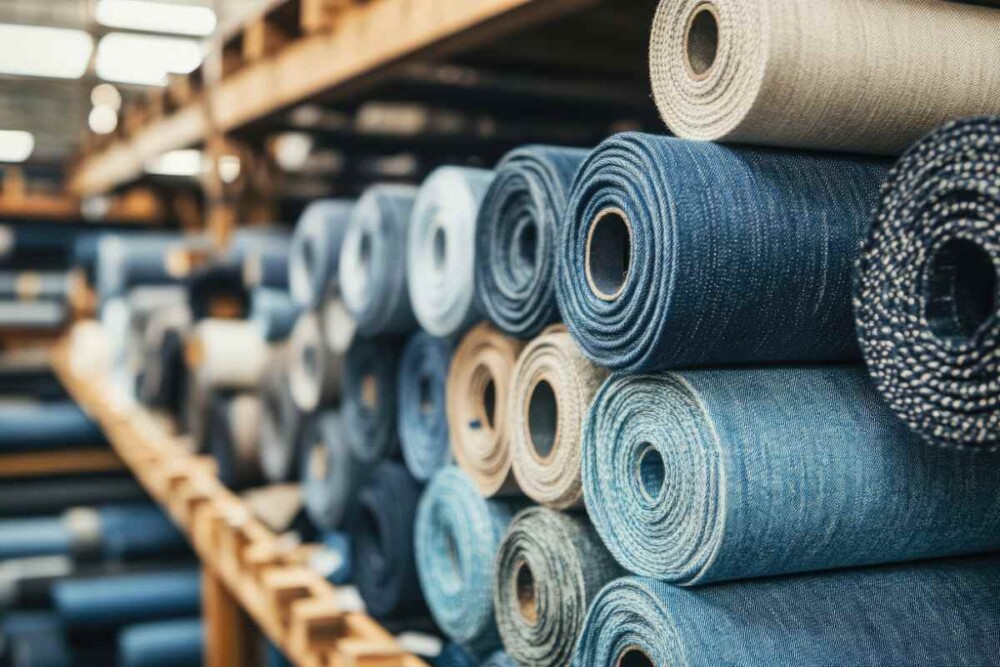
Denim is a twill weave fabric constructed with dyed warp and undyed yarn weft: this asymmetry gives rise to the compact blue forehand and lighter reverse, making it immediately recognizable. It is therefore the construction that defines it, not the fiber used.
The base is cotton, pure in traditional constructions or in melee in contemporary versions. Alongside the elastane of stretch fabrics are synthetic and artificial fibers used to lighten the fabric, increase its dimensional stability, or contain its cost, with direct effects on shedding and washing behavior.
In current usage, denim and jeans are synonymous, but they indicated two distinct fabrics. In denim the warp thread was blue and the weft thread was white or ecru. In jeans, however, the warp and weft had the same color, almost always blue. The distinction appears in John Hoye’s “Stample cotton fabrics”, published in the United States in 1942, which describes jeans as a monochrome cotton twill used for trousers, sportswear, sanitary uniforms, and for lining footwear, while allocating denim to heavy-duty clothing.
From Chieri to Nîmes: The Italian Origin of Jeans Fabric
The history of the fabric begins in Piedmont. In Chieri, in the 15th century, a very resistant blue fustian dyed with woad was produced. In the French city of Nîmes, a similar fabric developed in parallel, the serge de Nîmes, whose name was later shortened to denim.
The Piedmontese fabric, on the other hand, followed the trade route of the port of Genoa, where it was used for the sails of ships and to cover goods on the docks. The Americans distorted the French expression bleu de Gênes, the blue of Genoa, to the point of obtaining the term blue jeans. Two European cities, therefore, for two names that today indicate the same material.
How Denim Fabric Is Made: Weave, Spin, and Dye
The construction of denim is based on three elements that determine its packaging behavior: the type of armor, the warp spinning, and the dyeing method.
Twill armor and the three types of diagonal
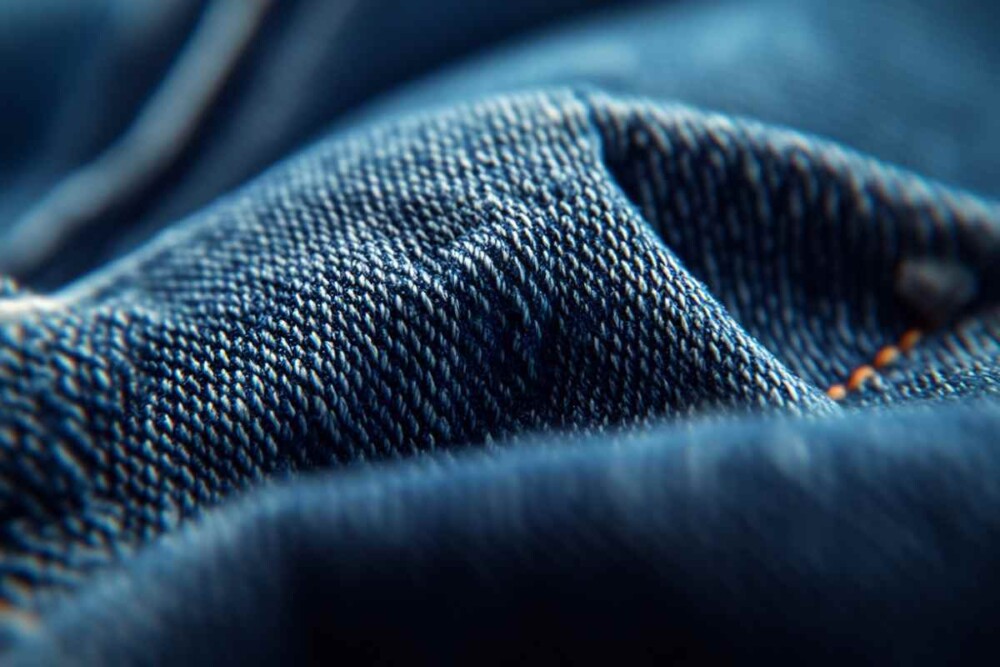
Denim is worked on twill weave, generally in a three-to-one ratio, where the warp thread passes over three weft threads and under one. Hence the visible diagonal on the right. The direction of that diagonal is not an aesthetic detail, because it affects the hand of the fabric and the behavior of the finished garment.
| Type of twill | Direction of diagonal | Fabric behavior |
| Right hand twill | From bottom left to top right | Compact construction and drier hand; it is the most widespread in industrial production |
| Left hand twill | From bottom right to top left | After washing it is softer and develops more marked nuances |
| Broken twill | Interrupted and alternating diagonal | Introduced in the mid-sixties precisely to counteract the twisting of the leg in the finished head |
From fiber to thread: warp spinning
Processing starts with cotton fiber, which is cleaned and mixed to even out the batches. This is followed by carding, which separates the fibres and collects them into ribbons, then stretched and twisted until a continuous thread is obtained, wound on spools. In traditional denim, the warp is a twisted yarn, while the weft remains carded: it is this difference in construction between the two systems that generates the irregular surface that the fabric develops with use.
Indigo dye and why jeans fabric releases color
Denim is dyed when it is still in the thread state, before weaving. The dye settles on the outer layer of the yarn through successive baths and oxidation, leaving the heart of the yarn naturally white. It is the process called ring dyeing.
This construction explains two behaviors that are often mistaken for production defects. The first is the discharge of color in the first washes, due to the unfixed surface dye. The second is the nuances that form with use: abrasion consumes the dyed layer and exposes the light heart of the thread, generating the whiskers on the thighs and the vertical ribs typical of the worn garment.
Not all denim behave like this. In double-dyed constructions, typical of solid blacks, both thread systems are dyed: the fabric maintains a uniform tone and does not develop the clear shades characteristic of indigo. It’s a choice to consider when the boss doesn’t have to age on sight.
For those who produce this, it involves precise operational foresight. In garments that combine denim with light-colored fabrics, or in coatings intended for prolonged contact, the risk of color transfer must be assessed before production by testing the fabric in wet conditions on a sample of the material with which it will be paired.
Denim Ounces: How to Read the Weight of Jeans Fabric
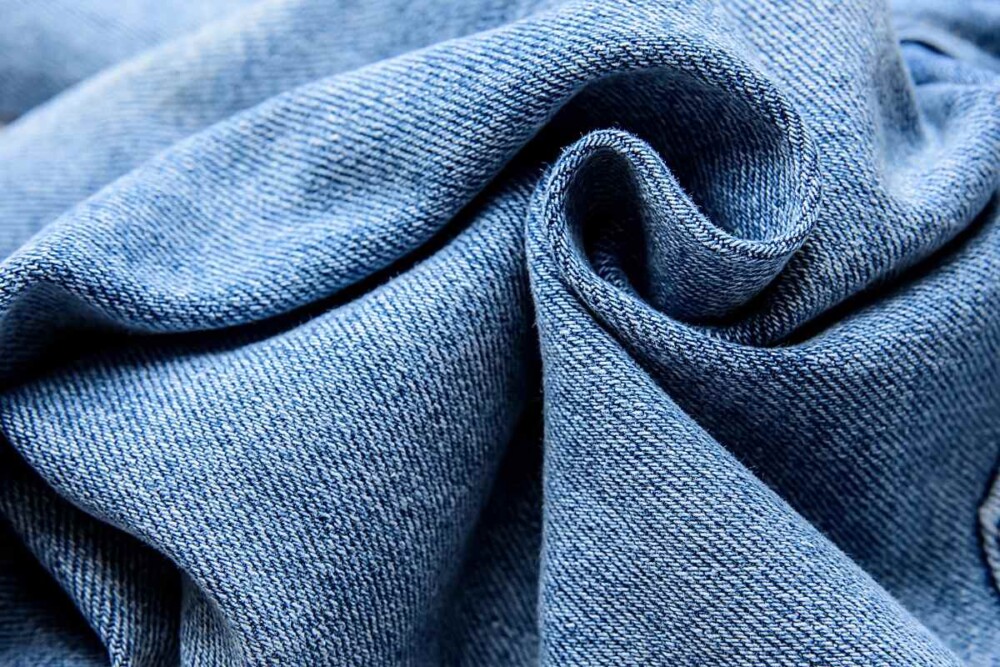
Denim weight is traditionally expressed in ounces, but the same figure indicates different weights depending on the convention adopted by the supplier. It is the main source of misunderstandings in textile purchases.
The prevailing international convention is the ounce per square yard, denoted as oz/yd², where one ounce per square yard corresponds to approximately 33.9 grams per square meter. Some suppliers instead express the weight in ounces-mass referred to the square meter, where one ounce is equivalent to 28.35 grams. The gap between the two readings exceeds twenty percent.
| Trade name | Read as oz/yd² (× 33.9) | Read as an ounce per m² (× 28.35) |
| 8 oz | ≈ 271 g/m² | ≈ 227 g/m² |
| 10,5 oz | ≈ 356 g/m² | ≈ 298 g/m² |
| 12 oz | ≈ 407 g/m² | ≈ 340 g/m² |
| 13,5 oz | ≈ 458 g/m² | ≈ 383 g/m² |
| 14 oz | ≈ 475 g/m² | ≈ 397 g/m² |
| 16 oz | ≈ 542 g/m² | ≈ 454 g/m² |
What weight to choose based on the garment to be packaged
The basis weight of the fabric determines fall, shape retention and workability. These are the reference bands expressed in grams per square meter, the unit that allows comparison between suppliers.
| Weight range | Fabric behavior | Typical destination |
| 200 – 250 g/m² | Soft, smooth drop, simple stitching | Shirt shop, light dresses, skirts, spring-summer garments |
| 250 – 320 g/m² | Balance between structure and comfort, often elasticized | Everyday trousers, lightweight jackets, fitted garments |
| 320 – 420 g/m² | Structured, holds its shape, requires dedicated needles | Classic jeans, denim jackets, outerwear |
| Over 420 g/m² | Rigid, high abrasion resistance | Workwear, workwear, technical applications |
The most used types of denim fabric in packaging
Under the name denim, very different constructions are grouped together, which behave differently in cutting, sewing and washing.
| Typology | Construction | What it entails in production |
| Rigid or crude denim | 100% untreated cotton after weaving | Marked shrinkage at first wash; it is progressively shaped with use |
| Sanforized denim | Mechanically pre-retracted in finishing | Dimensional stability and constant sizes after washing |
| Stretch denim | Cotton with a proportion of elastane, as a rule between 1% and 3% | Allows for snug fits; requires control over elastic recovery and twisting |
| Lightweight denim | Weights less than 250 g/m² | Suitable for summer shirtmaking and garments, simpler stitching and less thickness |
| Denim with selvedge | Fabric on shuttle looms, self-finished edge | Reduced heights and lower shear yield, compared to a higher density |
| Denim in melee | Cotton with artificial or synthetic fibres, lyocell or polyester type | Smoother drop or greater dimensional stability, depending on the associated fiber |
| Trichotated denim | Knitted construction instead of on loom | Reproduces the look of denim with the comfort of a maglina; simpler stitching, less shape retention |
| Bull denim | Very compact twill, high weights | Technical use and workwear; requires appropriate machines and needles |
Rigid or stretch denim: how to decide
The choice does not depend on the style of the garment but on the fit you want to achieve and the workmanship planned downstream.
Rigid denim provides a clean structure and lends itself to garments that need to maintain their shape over time, but it does not tolerate tight fits without limiting movement. It is also the substrate that responds best to aging treatments, because the untreated surface develops more marked contrasts.
Stretch denim allows for skinny and slim fits while maintaining comfort, but introduces two variables to be tested in sampling. The first is elastic recovery, which determines whether the head deforms at the knees after a few hours of use. The second is the twisting of the leg, which occurs when the construction has not been heat-set correctly and which becomes evident only after the first house washes, when the garment is already on the market.
Selvedge denim and cutting yield
Selvedge denim is created on shuttle looms, which produce a self-finished, non-frayable edge. Processing is slower and heights are significantly reduced compared to production on modern looms, so the cost per garment increases both due to the price of the fabric and the lower positioning efficiency.
It makes sense when the selvedge becomes an element of product recognizability, typically in the lapel of the trousers, and when the positioning of the garment justifies the higher industrial cost. For volume production on a standard fit, the yield doesn’t pay for it.
Denim, gabardine, drill and canvas: how they stand out
They are sturdy fabrics, traditionally based on cotton, and are often confused with each other. However, they differ in construction and intended use.
| Fabric | Construction | Appearance and hand | Main use |
| Denim | Twill with dyed warp and natural weave | Blue obverse, lighter reverse, surface that wears away on sight | Jeans, jackets, workwear, casual decor |
| Gabardine | Thick twill with dyed warp and weft | Thin and uniform diagonal, compact and smooth hand | Formal trousers, uniforms, outerwear |
| Drill | Coarser twill than gabardine | Opaque surface, marked diagonal | Workwear, sturdy trousers |
| Canvas | Canvas armor, coarse yarns | Flat, rigid surface, without diagonal | Canvas bags, drapes, footwear, light upholstery |
The most significant operational difference concerns aging. Denim is the only one of the four where wear is a sought-after aesthetic value, because ring dye progressively exposes the light heart of the thread. In the other three, abrasion simply produces a worn garment.
Retreat and sanforization: how much denim fabric to order
Unsanforized denim reacts to the first wash by shrinking on average between ten and twelve percent. On significant production sizes, the figure is not marginal: ignoring it means out-of-size garments and scrap of already cut fabric. Sanforization processes contain withdrawal within much lower percentages, but the value must be verified on the individual batch, because it varies with the construction and the finishing applied.
The correct process before launching a production involves three steps. A sample is washed according to the cycle provided for the finished garment, shrinkage is measured on the warp and weft separately, because it is never symmetrical, and consumption is recalculated on that data instead of on the dry measurement.
How much denim is needed for a pair of pants
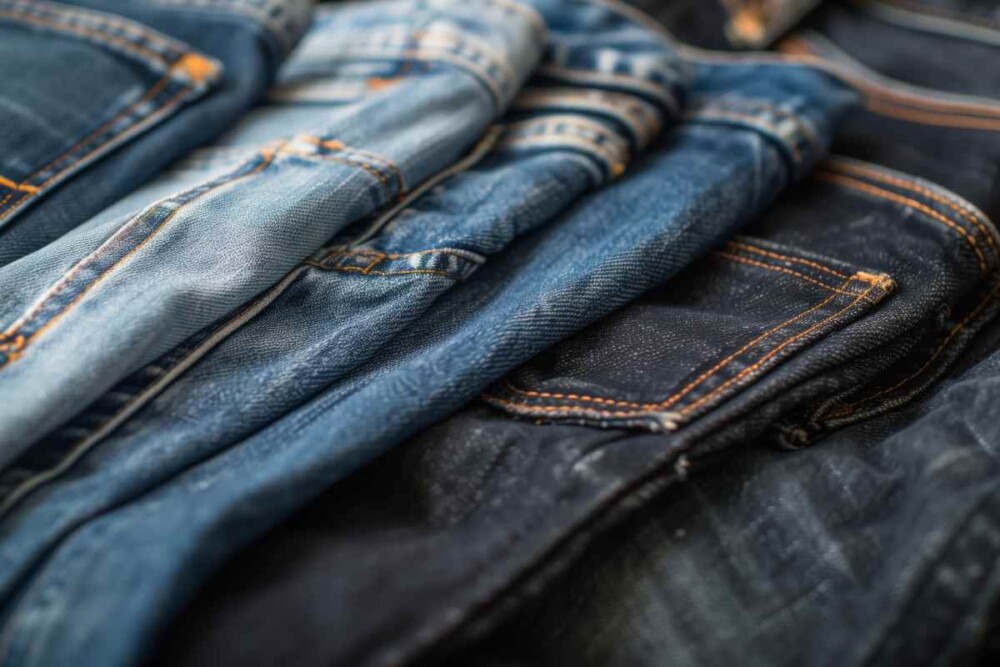
The following consumption is indicative and refers to a patch height of 150 centimetres, with standard placement and no fancy match. The actual data depends on the model, size and efficiency of the marker.
| Garment | Indicative consumption (h 150 cm) | Notes |
| Adult five-pocket trousers | 1,4 – 1,7 m | Varies with size and leg width |
| Knee-length denim skirt | 0,8 – 1,1 m | Low consumption, good positioning performance |
| Adult denim jacket | 1,8 – 2,2 m | Increase with long sleeves and patch pockets |
| Light denim shirt | 1,6 – 2,0 m | They engrave neck, cuffs and yoke |
To these values must be added the percentage of shrinkage detected on the sample, if the fabric is not sanforized, and a margin for patch defects, which in yarn-dyed fabrics are concentrated mainly in the warp.
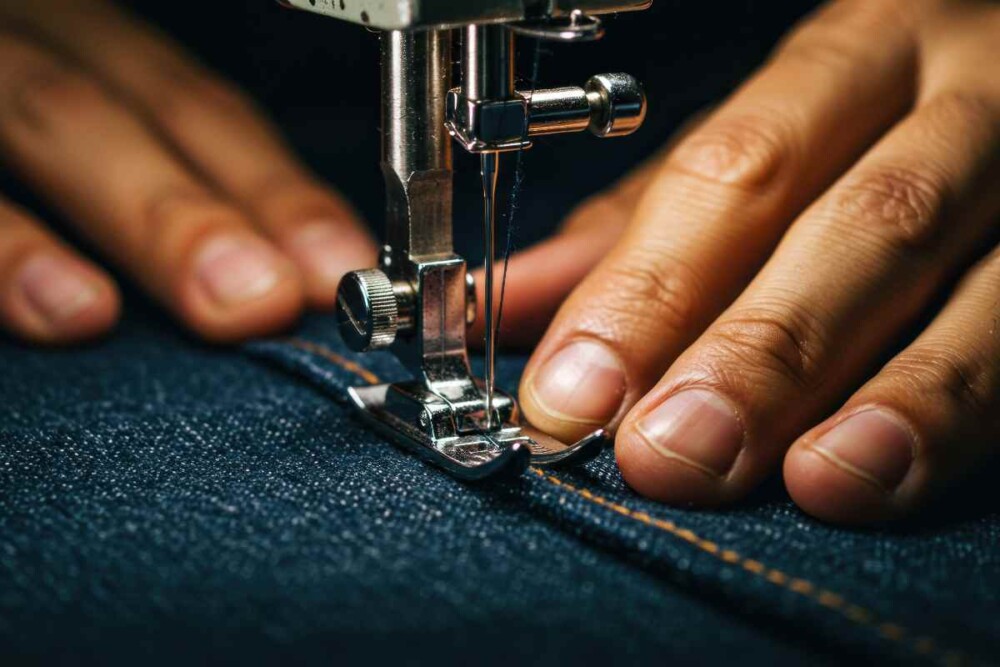
Sewing Denim: Needles, Yarns, and Packaging Tips
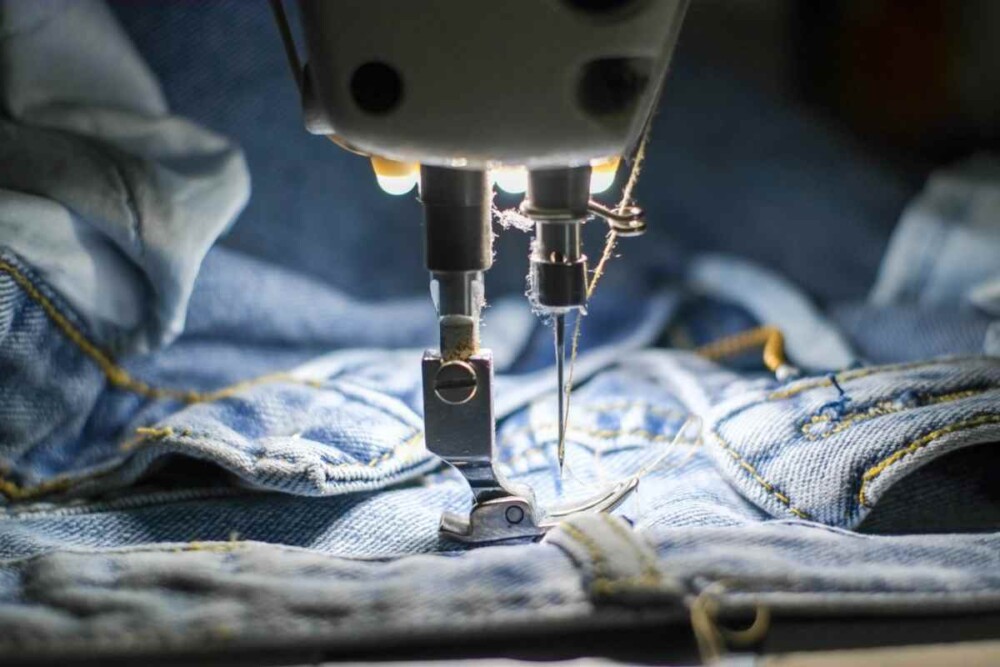
Denim puts more strain on machines and consumables than almost any other clothing fabric, especially where multiple layers overlap.
Needles and yarns
- For medium weights, work is done with needles from 90/14 to 100/16; above 400 g/m² and the thicknesses are increased up to 110/18.
- The tip should be chosen with a round blade to avoid shearing the warp yarns, with a reinforced shank to resist bending on the thicknesses.
- The structural sewing thread is generally twisted polyester, which maintains tightness and dimensional stability in the wash.
- For exposed topstitching, larger yarns in a contrasting colour are used, with a stitch length of around 3 – 3.5 millimetres to obtain the typical relief of the garment.
Packaging adjustments
- The shims should be beaten before sewing to reduce the height difference and prevent needle breakage.
- The crotch and side seams require high-strength stitches, because they are the stitches where the garment gives way first.
- Pockets should never be made with the same outer fabric: you need dedicated canvases, which absorb abrasion without weighing down the garment.
- On stretch denim, ironing must be kept at a controlled temperature, because excessive heat compromises the recovery of the elastane.
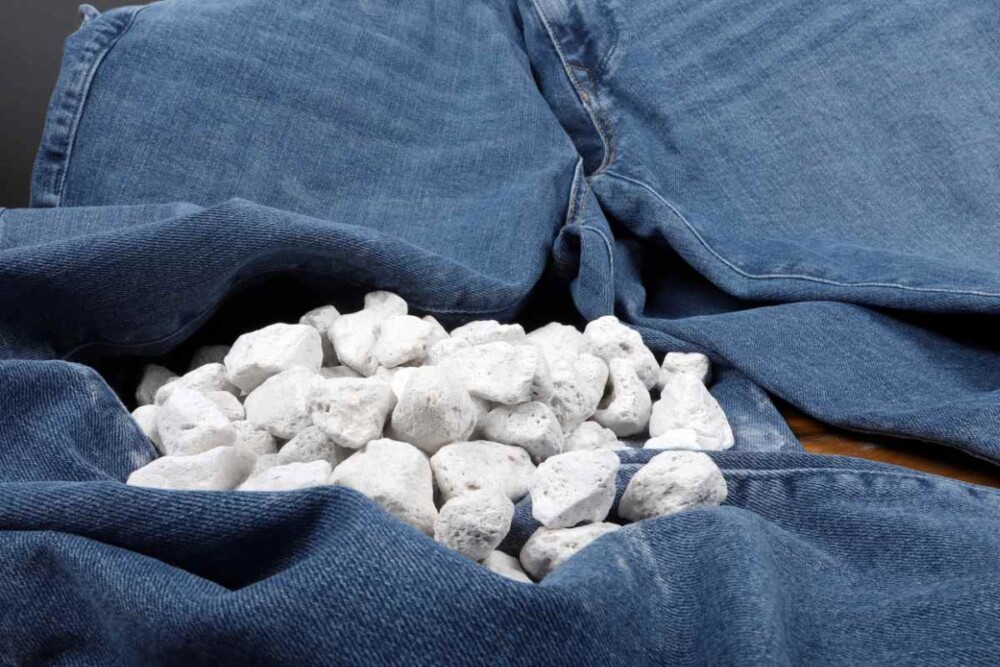
The treatments and washes of denim fabric
Denim lends itself to a wide range of finishes, applied after weaving or directly to the packaged garment, which modify its color, contrast and hand.
| Treatment | Proceeding | Result |
| Rinse wash | Simple washing in water | Eliminates initial stiffness while maintaining dark tone |
| Bleached | Washing with added chlorine | Lightened shades, up to super-bleached versions |
| Tie-bleached | Fabric tied during washing | Randomly distributed irregular patches of color |
| Stone washed | Washing with pumice stone | Uniform aging and softened hand |
| Stone bleached | Pumice combined with bleaching agents | Effect consumed with marked lightening |
| Used | Localized abrasion or targeted chemical treatment | Concentrated wear on knees, thighs and pocket edges |
Each treatment affects the residual strength of the fabric. More aggressive finishes reduce tear tightness, so on garments intended for intensive use it is advisable to check the values after finishing and not on the raw fabric.
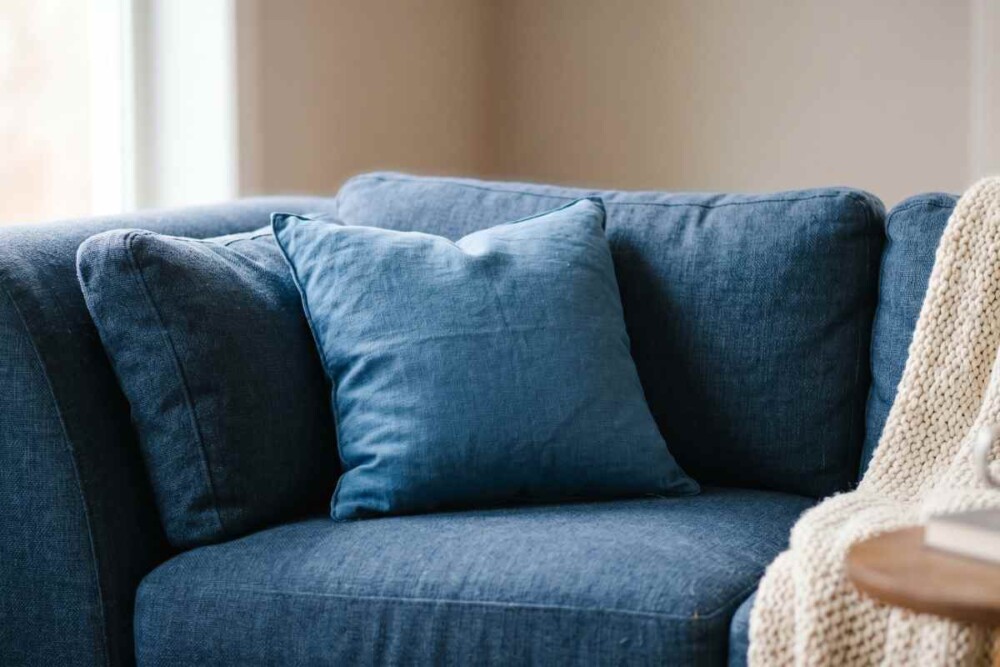
The uses of jeans fabric beyond clothing
The jeans fabric per meter serves primarily for the packaging of trousers, jackets, overalls, skirts and accessories such as bags and footwear. However, its abrasion resistance makes it suitable for very different areas.
In home furnishings and linens, denim is used for upholstery sofas, armchairs, ottomans, and chairs, as well as for tablecloths and informal accessories. In these uses, the required weight increases compared to clothing and the solidity of the color becomes decisive, to avoid transfers to light fabrics.
In the industrial sector, fabric finds its way into certain types of work uniforms, tarpaulins, and technical drapes, where it is primarily important to maintain it over time and maintain it easily.
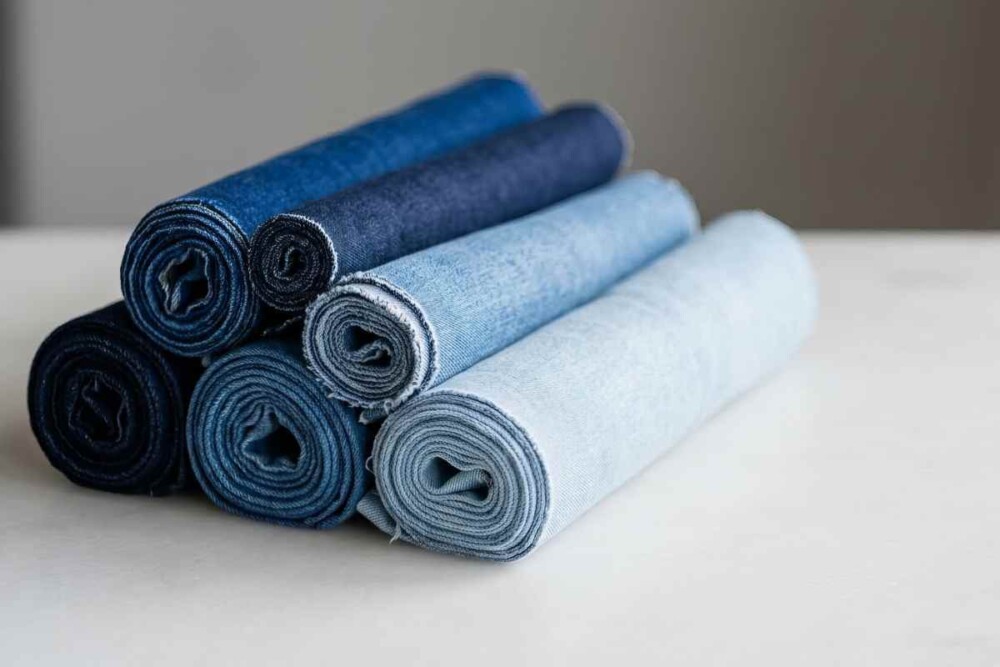
The denim fabrics of the Cimmino catalogue
The denim fabrics distributed by Manifattura Foderami Cimmino are intended for tailors, ateliers and packaging designers, and are selected to meet the most common processes in clothing.
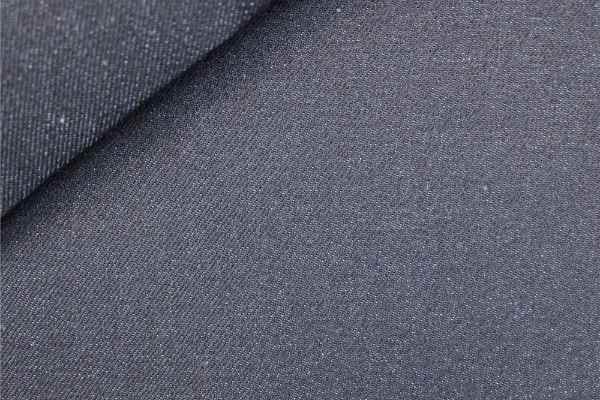
Jeans Phoenix 8 Oz
Jeans Phoenix 8 Oz is a pure cotton denim, without elastane, with a rigid structure and a dry hand. Its low weight places it in the lightweight band, where the rigid construction ensures a hold on the shape without weighing down the garment: a combination suitable for light shirts, skirts, dresses and outerwear, as well as classic-fit trousers.
Jeans Elastico Harlem 10,5 Oz
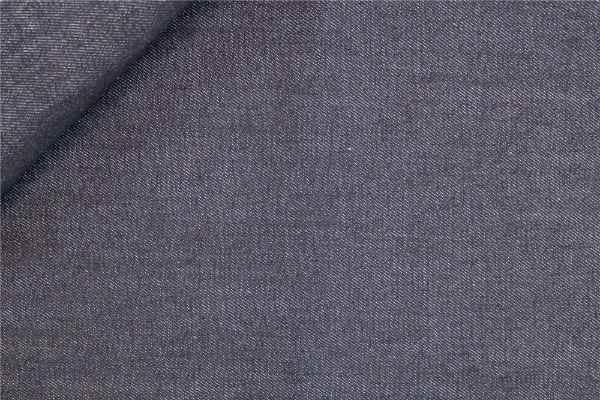
Stretch denim fabric with a small amount of elastane, on medium weight. It is the most used weight band in everyday trousers, because the structure remains full-bodied enough to support the shape of the garment while elastane allows for snug fits without limiting movement. The reduced percentage of elastic fiber of the fabric Jeans Elastico Harlem 10,5 Oz maintains the prevailing character of cotton, with a hand closer to traditional denim than constructions with marked elasticity.
Denim Glossary
| Term | Meaning |
| Twill armor | Weaving structure that generates the visible diagonal on the right of the fabric |
| Bull denim | Very compact twill denim with a high weight, intended for technical uses |
| Selvedge | Self-finished edge of the piece, produced by shuttle frames |
| Broken string | Interrupted diagonal construction, adopted to counteract leg torsion |
| Weight | Fabric weight per unit area, expressed in grams per square meter |
| Oncea (oz) | Unit of weight of denim, referring to the square yard or to the square metre |
| Warp | Set of longitudinal threads of the fabric; in denim it is the dyed part |
| Elastic recovery | Ability of an elasticized fabric to return to its original shape after extension |
| Ring dyeing | Ring dyeing that colors only the outer layer of the yarn |
| Sanforization | Mechanical pre-retraction that reduces shrinkage to washing |
| Stone washed | Finishing with pumice stone that softens and ages the fabric |
| Heat setting | Heat treatment that stabilizes elastic fibers |
| Texture | Set of transverse threads; in classic denim it remains in undyed yarn |
| Double dyed | Denim with both systems of dyed threads, which does not develop clear shades |
| Twill | English term for twill armor |
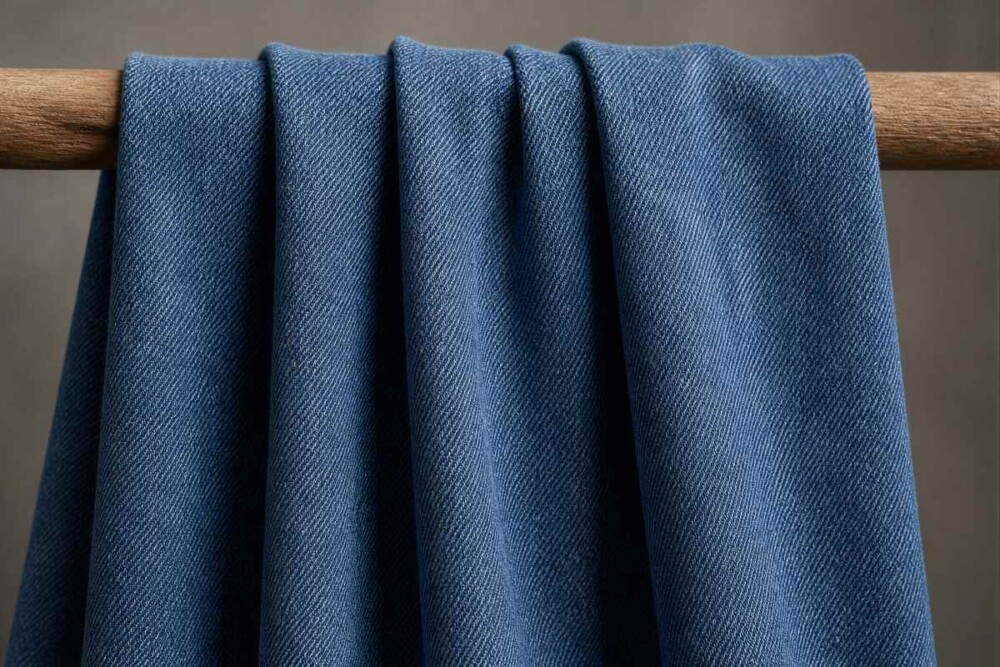
Wholesale denim fabric for tailoring and packaging
Manifattura Foderami Cimmino selects and distributes denim fabrics for tailors, ateliers, packagers and retailers, together with the range of linings and canvases necessary for the garment’s packaging. Each supply is accompanied by the complete technical specifications, with weight expressed in grams per square metre and weight per linear metre, so as to allow an immediate comparison between the different alternatives.
To check availability, color folders and supply conditions, consult the online fabric catalog.
FAQ – Frequently Asked Questions About Denim Fabric
Today the two terms indicate the same fabric. Historically, denim had a blue warp and light weft, while jeans had a warp and weft of the same color. The first name derives from the city of Nîmes, the second from the port of Genoa.
It depends on the convention adopted by the supplier. With the international standard in ounces per square yard it is multiplied by approximately 33.9 to obtain grams per square meter, while with the convention in ounces-mass per square meter it is multiplied by 28.35. To compare different suppliers it is advisable to always ask for the gram weight per square meter.
The bands under 250 grams per square meter are the most suitable, because they maintain morbidity and fall without irrigation of the neck and cuffs. Above 300 grams per square meter, the fabric is difficult to work in the shirt shop and weighs down the garment.
Unsanforized denim can withdraw on average between ten and twelve percent. Sanforized fabrics contain shrinkage within much lower values, which must still be checked on the individual batch before calculating production consumption.
The indigo dye settles only on the outer layer of the yarn and leaves the core white. In the first washes, the unfixed dye comes off, while the use abrasion progressively consumes the dyed layer and generates the characteristic shades of the worn garment.
No. It allows for snug fits but introduces elastic recovery and torsion variables that must be controlled in sampling. For structured garments that must maintain their shape over time, a rigid construction remains preferable.
With a patch height of 150 centimetres, approximately between 1.4 and 1.7 metres are needed for five-pocket adult trousers. Real consumption depends on the model, size and efficiency of the placement, and must be increased in shrinkage if the fabric is not sanforized.
For average weights, needles from 90/14 to 100/16 are used, while above 400 grams per square meter and on thicknesses it reaches 110/18. The tip should be chosen as a round blade so as not to shear the warp yarns.
It indicates a fabric subjected to mechanical pre-retraction during finishing, which reduces shrinkage in the wash and ensures stable sizes in the finished garment. It is the safest choice in volume production, where size variability generates waste.
Both are twill weaves, but in denim the warp is dyed and the weft remains natural, while in gabardine both systems are dyed. The result is a uniform surface and a more compact hand, suitable for formal, split trousers rather than garments intended to age on sight.
